Medicines for face pain

Medicines for face pain treatment

Medicines for face pain treatment are generally those that are used to treat fits (convulsions, seizures). These come under the group called anti-convulsants (they numb the brain and prevent response to stimuli).

While there are many medicines that could be used, some are similar to the older versions, some are very different; and some medicines are not related at all. Acupressure, acupuncture, Ayurveda and Homeopathy have also been tried.

How do medicines act?

Basically, all act by numbing the brain. The intent is to reduce reactivity of the trigeminal nerve, but no medicine can act on just one nerve. It therefore acts on the entire nervous system, numbing it. This is the primary reason for the major side-effects of medication.

So, for most people, medication is the first line of treatment. Most of them are off-label for the treatment of facial pain. Most patients need to adjust the medication with varying combinations and dosages to get the best pain relief effect with minimal side-effects.

The following video describes the typical journey of a patient who has started having facial pain on one side of the face:

Which medicines are commonly used to treat face pain?

Among the medicines that are used for treatment of trigeminal neuralgia and face pain are

Carbamazepine/Oxcarbamazepine/Eslicarbamazepine,

Gabapentin/Pregabalin,

Phenytoin and other anti convulsants,

some antidepressants,

skeletal muscle relaxants,

anaesthetics

toxins.

These medicines have different formulations and trade names.

How are medicines to treat TN pain started?

Initially only one drug is generally started, at a small dose, then the dose is increased as necessary. If the pain continues to increase in intensity and frequency, a second or third drug may be added. Please be sure to talk to your doctor about the effect and side-effects that you experience. Please look out for rashes or itching or some other sign that you maybe allergic to the drug.

Are there any specific drugs for TN pain?

There is a new drug that is being developed specifically for trigeminal neuralgia pain. Research is still on, and it is in the planning stage.

Please be sure to talk to your doctor about the effect and side-effects that you experience.

What are the side-effects of medicines used to treat face pain?

Common side effects of Medicines used for treatment of facial pain:

Memory loss

Reduced co-ordination

Confusion

Weight gain

Loss of balance

Drowsiness

Difficulty in finding the right words

Fatigue

Irritability

Dry Mouth

Nausea etc

Can these drugs be stopped suddenly?

No. Stopping the medicines used to treat your TN pain is as challenging as starting you on them.

Because of the need to titrate your dosages, or shift to a different medication you need to know this.

We need to change dosage or type of medicine if you are not responding,   nature of pain has changed. a nerve block injection has failed or pain has recurred.

Typically, the medicines in high doses are tapered off over few weeks before stopping completely. This is especially true after you have undergone a successful MVD surgery. Dr Jaydev Panchwagh and his team have a specific protocol for tapering these drugs.

So, what can be expected during withdrawal?

Typically, one notices dizziness, nausea, increased pain, agitation, confusion, disorientation, violent dreams, tremors, irritability etc

Where can I find more information on the medicines?

We have an entire website dedicated to treatment of Trigeminal neuralgia pain. You can find information here.

Is there any alternative to medicines?

Yes, people try naturopathy, Homeopathy, Ayurveda, or Acupuncture, Acupressure and others.

Some people believe exercises help them. Some make adjustments in food.

What if medicines for treating the pain of trigeminal neuralgia have stopped working?

Do not worry! There are alternative treatments available. Nerve injections and Gamma knife procedures are nerve destructive procedures. Their effect is generally temporary. The success rate for pain relief is also less as compared to surgery.

Surgery for TN is called Microvascular Decompression (MVD surgery). It is generally a nerve preserving procedure, offers the potential of permanent pain relief. You can learn more about this here and here.

Dr Jaydev Panchwagh is the chief Neurosurgeon and Director of the Centre of excellence for MVD surgery in Pune, India. He has been keenly focused on MVD surgery for nearly twenty years and has operated on patients from more than 22 states in India, and about 13 countries around the world. He has performed more than 1900 MVD surgeries as of this date.

You can find more information on his work here.
चेहरे की नसो में दर्द

चेहरे की नसो में दर्द क्या कहलाता है?

चेहरे की नसो में दर्द का नाम ट्राइजेमिनल न्यूराल्जिया है।

Trigeminal neuralgia का दर्द कैसा रहता है? trigeminal neuralgia का दर्द बहुत ही भयानक और असहनीय होता है. कभी बिजली जैसा दर्द, तो कभी चुरी चुभो रहा हो ..इस जैसा…कई प्रकार है.

इसके कई कारण होते हैं । सबसे आम कारण ट्राइजेमिनल तंत्रिका को संकुचित करने वाली रक्त वाहिका है ।

शुरू में इस बीमारी को ठीक करने के लिए दवाइयां दी जाती है..जैसे की Tegretol, Mazetol या Carbamazepine.

दर्द का वजह नस का कम्प्रेशन होता है. यह MVD surgery से ठीक हो सकता है.

ट्राइजेमिनल न्यूराल्जिया  क्यों होता है?

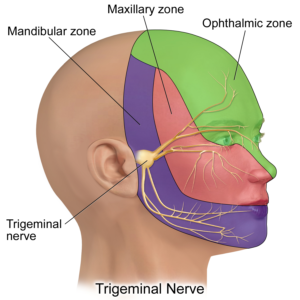
चेहरे का दर्द ट्राइजेमिनल तंत्रिका के संपीड़न के कारण होता है । चेहरे की नस को Trigeminal Nerve नाम  से जाना जाता है. इस तंत्रिका के तीन भाग होते हैं, जो चेहरे के ऊपरी, मध्य और निचले हिस्से को सप्लाई करते हैं.

चेहरे में दर्द , एक दुर्लभ nerve का विकार है। यह चेहरे के गंभीर दर्द का कारण बनता है.

Trigeminal nerve distribution
(pic courtesy: Wikicommons)


गाल में दर्द या जबड़ा में दर्द ट्राइजेमिनल न्यूराल्जिया के कारण भी हो सकता है। Neuralgia याने नस में दर्द होना. इसी लिए इस नस के दर्द के बीमारी को {चेहरे की नसो में दर्द) trigeminal neuralgia बोलते हैं.

चेहरे  की नसो में दर्द (trigeminal neuralgia) का इलाज क्या है?

चेहरे की नसो में दर्द का इलाज, पहले दवाई से की जाति है। अगर दर्द कम नहीं हुआ तो एमवीडी (MVD) सर्जरी कर सकते हैं। यह ऑपरेशन न्यूरोसर्जन करते हैं.

ट्राइजेमिनल न्यूराल्जिया का दर्द कैसा होता है?

रोगी को तेज बिजली की तरह का झटका लगता है जैसे आंख, गाल, मसूड़े या जबड़े में बिजली का दर्द ।

क्या यह कान के दर्द के रूप में भी उपस्थित हो सकता है?

हां। TN भी कान में दर्द पैदा कर सकता है; लेकिन यह ग्लोसोफेरींजल न्यूराल्जिया से भी जुड़ा हो सकता है।
यदि आप ट्राइजेमिनल न्यूराल्जिया के बारे में अधिक जानना चाहते हैं, तो कृपया इस वीडियो पर क्लिक करें ।
 
Dr. जयदेव पंचवाघ न्यूरोसर्जन हैं । वह पुणे में एमवीडी सेंटर के निदेशक (डाइरेक्टर) हैं ।

उनका अनुभव बहुत विशाल है । उन्होंने अब तक 1850 से अधिक MVD सर्जरी की हैं.

अगर आप इसका इलाज के बारे जानना चाहते हैं, तो यह विडियो आपको उपयुक्त होगा…


Is MVD surgery risky?

Is MVD surgery risky?

This is a transcript of an interview with Dr Jaydev Panchwagh, neurosurgeon. This was aired on TV. He is the Director of the MVD Centre in Pune.

Trigeminal Neuralgia: General Information

Interviewer: Doctor, I read up some articles on Trigeminal Neuralgia before this interview. It appears that the patients are affected by a very severe kind of pain in the face.

Dr Jaydev Panchawagh: Yes!! The pain is so severe and comes so suddenly that some patients even contemplate suicide!! The pain is variously described as sharp, stabbing, burning, shock-like etc.

Trigeminal Neuralgia: Treatment choices

Interviewer: I also read that there are many kinds of treatments available, but none really effective. Is that correct?

Dr Jaydev Panchawagh: Treatment of Trigeminal neuralgia is usually started with medicines (tegretol, Carbamazepine). Initially they are effective. But over a period of time, the pain takes over. We need to increase medicine doses. The pain gets controlled. Then over the next few months, medicines lose their effectiveness. The doses need to be further increased or medicines changed. This goes on till the pain becomes unbearable or the medicine’s side effects are not tolerated. The patient then has to consider other options. But in our MVD Centre, we often give the option of surgery before very high doses of medicines are reached. Because, the side effects are at this time unacceptable.

There are other treatment options like RFLG,  nerve Blocks balloon compression , or Gamma knife radiation but my particular preference has generally always been MVD surgery.

Trigeminal Neuralgia: MVD surgery

Interviewer: So, is MVD surgery a brain surgery?

Dr Jaydev Panchawagh: Yes, MVD or MicroVascular Decompression surgery is a brain surgery. The operation is performed where the Trigeminal nerve exits from the brainstem. It is in a very deep part of the brain.

Interviewer: Is MVD surgery risky?

Dr Jaydev Panchawagh: It is fairly safe in the hands of an experienced surgeon. The more MVD surgeries one performs, the more comfortable one becomes with the anatomy there. We become more aware of what to expect, what to do, what not to do. So the chances of success in the surgery also is much higher than in the hands of an inexperienced surgeon. This is one of the reasons why MVD surgery is best done at Centres which have a high volume of these surgeries. 

Why experienced neurosurgeon matters?

The patient must therefore find out how many such surgeries the surgeon has performed. The potential risks could be infection, bleeding, hearing loss, facial numbness, and/or facial weakness (generally temporary),  CSF leak, difficulty to talk/ swallow, stroke/ paralysis/risk to life (extremely rare).

Interviewer: Doctor, how many MVD surgeries have you performed so far?

Dr Jaydev Panchawagh: I have performed more than 1600 surgeries so far (from 2002 to 2022). You can access the testimonials of some of the patients here.

Interviewer: What is the aim of MVD surgery?

Dr Jaydev Panchawagh: The final goal is to prevent pain that arises because of compression of the Trigeminal Nerve either by a blood vessel or by brain tumors.

Interviewer: Is MVD performed for treatment of Trigeminal neuralgia alone?

Dr Jaydev Panchawagh: No, MVD can be performed for treatment of Hemifacial spasm ( affecting the Facial nerve) or Glossopharyngeal Neuralgia(affecting the glossopharyngeal nerve). You can know more about this in my video explaining Hemifacial spasm symptoms and causes.


You may watch this video to know more about Glossopharyngeal neuralgia .


What is Trigeminal neuralgia?

What is Trigeminal Neuralgia?

Trigeminal neuralgia is a chronic facial pain caused by a hyperactivity disorder of the Trigeminal nerve. In simple words, it is a symptom of Trigeminal nerve compression. This compression could be caused by a blood vessel or by a tumor, among many other causes. TN  pain is severe and is generally treated with medicines, initially.

What is the trigeminal nerve?

Trigeminal nerve is the fifth nerve which is given off from the brain. It is a cranial nerve. This is a sensory as well as motor nerve. It means that the nerve supplies sensation to the face and the motor component supplies muscles of chewing.

What is the commonest presentation of trigeminal neuralgia?

Commonly TN pain begins after some form of dental treatment, either an extraction or root canal work. However, the dental work actually is only a trigger, not the cause. Other triggers for the trigeminal neuralgia pain are brushing, eating, talking, shaving, touching etc.

Can Trigeminal neuralgia be associated with ear pain?

Yes. TN itself can cause ear pain; but it may also be associated with Glossopharyngeal neuralgia which can also be the cause of ear pain.

How is the pain of Trigeminal neuralgia?

The patient has severe electric shock like or lightning like pain in the eye, cheek, gums or jaws. Mostly, this disorder is diagnosed late. Thus the patient suffers for many years before they are told their diagnosis. It is frequently mistaken for migraine, dental pain or ear pain. MRI is performed to support the clinical diagnosis.

Can MVD be done after RFLG?

Yes, but a primary MVD always gives better success. Radio Frequency Lesioning or ablation of the trigeminal nerve is a destructive procedure. MVD surgery is a nerve-preserving procedure.

Who performs the MVD surgery?

MicroVascular Decompression (MVD) surgery is a brain surgery and is performed by a neurosurgeon. An experienced neurosurgeon gives the best results, better success rates and lower chances of risks.

Can we get any patient testimonials or their experiences?

Sure. Please click here to read and watch videos of patient experiences. All these patients have been operated by our team, at the MVD Centre. You can click here to read more Frequently Asked Questions on Trigeminal neuralgia and MVD surgery. You can visit the home page of this website on trigeminal neuralgia treatment by clicking here.

Who runs the MVD Centre?

The MVD centre is in Pune. The Director is Dr Jaydev Panchwagh, who has an experience of more than 30 years in the field of neurosurgery. His passion in the specialty is MVD surgery.


Is Trigeminal neuralgia hereditary?

For those of you who are wondering whether Trigeminal neuralgia is hereditary, the short answer is ‘ not really’. Having said that, there are cases reported where TN runs in families.

Can Trigeminal neuralgia be Familial?

Familial TN is unusual by all means. It is likely to be less than 2 or 3% of all TN patients. It is possible that patients inherit their familial ‘make-up’ of blood vessel contours or laxity, or lengths…we don’t know. Generally the familial type of Trigeminal neuralgia is on the same side in all affected family members.

Can Trigeminal neuralgia be inherited? Can TN be genetically transmitted?

The chances are so slim, that it’s not worth losing good sleep over it.

Have I seen a case of familial Trigeminal neuralgia?

‘No. I have only read case reports. It is likely that this condition is so rare, that one need not be too worried about it.’ Dr Jaydev Panchwagh answers.

Can children be affected with Trigeminal neuralgia?

Though it is unusual, it is not impossible. Diagnosing TN in children may be a problem, because they may not be able to express their problem clearly.

Parents ought to be more observant and help in establishing patterns.

There are reports of Microvascular Decompression surgery being done even in young children to treat them of the Trigeminal neuralgia pain.

My father and I both have Trigeminal Neuralgia. Is this hereditary? Will my children also have it?

It is possible that there are certain anatomical variations in either the brain and skull, or in the blood vessels that have predisposed both of you to have it. We just have to wait and see if it gets passed on to the next generation.

The youngest patient Dr Jaydev Panchwagh, a renowned Indian neurosurgeon  has operated on is a girl of 22 years, who had been having it for five years. The operation was performed at his centre for MVD in Pune, India.  With an experience of more than a thousand trigeminal neuralgia surgeries, he is one of the best neurosurgeons for such delicate and specialized operations.

You may watch his Youtube channel for more on MVD surgery for Trigeminal neuralgia treatment.

Is trigeminal neuralgia permanent?

Is Trigeminal neuralgia permanent? This is one of the first questions patients ask, upon learning their diagnosis. It is natural to want to know how long they have to face these facial pain-attacks.

The pain of a TN attack is itself not permanent, but comes intermittently most of the times. In a few patients this pain, especially in those who have had it for a long time, may last a few hours at a time.

Does the pain of Trigeminal Neuralgia (TN) ever go away?

Unfortunately, no. The pain attacks keep appearing. Initially, the attacks are infrequent, later they become more severe and frequent or even continuous. the timeline varies for every individual who suffers from this.

There are periods, sometimes for months when the pain does not re-appear. It is called pain remission. Some people have short remission periods, and for others it’s longer.

As the condition progresses, the remission periods shorten and the attacks become more frequent. Very rarely, there may be near-permanent remission.

How long does the pain of Trigeminal neuralgia last?

The actual pain attack of TN may last a few seconds to a few minutes. The actual condition is unlikely to ever go away. Most patients need a combination of medications to keep the pain under control. Non-medical therapy helps in managing pain, and living with it. Surgical procedures give longer pain  relief. Microvascular decompression surgery is the main option available for a possible permanent relief from the pain of Trigeminal Neuralgia.

Dr Jaydev Panchwagh and his team at the Centre for Trigeminal Neuralgia Treatment by Microvascular Decompression surgery have an experience of more than a thousand MVD procedures, in the last twenty years. The centre is known for the best treatment of Trigeminal Neuralgia.

Dr Jaydev Panchwagh is a renowned neurosurgeon in Pune, India and has many referrals from international patients as well. Plenty of video lectures delivered by Dr Panchwagh on the subject, are available on YouTube.


Calming an attack of trigeminal neuralgia

One of the most important questions I am asked, or rather one of the important phone calls I handle are tips on calming an attack of Trigeminal neuralgia. In other words:

How do I deal with a TN attack?

Well, primarily, it means that you have been diagnosed, and you recognize an attack. But before we learn how to deal with an attack of TN or learning how to calm the trigeminal nerve, we should first check that we have a few things in place.

  • Do you keep a pain diary? 

This is very important to recognize what events led up to the attack, its duration, frequency etc.

  • Have you noticed any trigger factors that bring on an attack?

There are different trigger factors for different people, but the commonest are touch, brushing,                  eating and talking. Maintaining a pain diary helps identifying trigger factors.

  • Have you noticed any actions that may reduce your pain?

Again, being observant and trying different remedies at home in the initial phases when the pain is            not so severe can help.

  • Have you noticed any foods that may bring on an attack?

Writing down in a pain diary will help narrow down pain-triggering foods. One of the problems of              Trigeminal neuralgia medication is that there is an obtundation of memory and recall. Writing                    down helps recall, and can help others also analyze the things that led up to the attack. Also,                        identifying pain-safe foods for you will help ward off an attack.

Simple measures that may help calming down a Trigeminal neuralgia attack

  • Hot water bottles / cold presses
  • Pressure of entire palm on affected side: cupping the face with palm
  • Medication like Tegretol, especially if you have forgotten to take a dose
  • Capsaicin or hot pepper creams
  • Seeking a calm atmosphere
  • Going indoors and avoiding breeze
  • Avoid long journeys
  • Drink from a straw, eat soft foods so you don’t have to chew
  • Light exercise to release natural pain-relieving hormones (for some, exercises like walking can worsen an attack).

My Trigeminal neuralgia attack keeps coming back. What do I do?

Unfortunately, if your TN attacks are non-responsive to medication and other measures, you might have to consider Microvascular decompression surgery. This is one of the treatment options, which when considered early on in the disease, can lead to a potential cure.


Dr Jaydev Panchwagh is a renowned neurosurgeon in Pune who is an internationally recognized surgeon for Trigeminal neuralgia treatment in India. he has performed over a thousand MVD procedures with a 98% success rate. He has an international patient service to help those patients coming from outside India.

He has a You Tube channel, Dr Jaydev Panchwagh, if you are interested in watching his lectures on Trigeminal neuralgia. There are also many patient testimonials, which help in allaying fear and anxiety about surgery. Our team has one of the best results in trigeminal neuralgia treatment in India.

You may contact the team which will lead you to avail of all our services.


Depression and chronic pain

People who suffer from Trigeminal neuralgia, which is a chronic pain condition, often have depression. I have written this blog to help understand how the pain-anxiety-depression cycle kicks in.
I remember a story told to us in childhood.
Akbar asked Birbal, what is the worst punishment for a human being? (Akbar was a powerful Mughal emperor in India and Birbal was his wisest court- minister).
Birbal said, “Sire, before I give you the answer to this question, may I ask you what do you think is the worst punishment ?”
“Why, Birbal, of course it is death penalty ! …I just want to know if you have any different thoughts.”
“Sire, the worst punishment is not death; it is a “continuous, chronic mental terror that death or pain is about to come. I do not wish this punishment upon my worst enemy too.”
“Surely Birbal, you are joking. How can anything be worse than death itself? You have to prove your claim” said the Emperor in his usual style.
And in his usual style, Birbal too arranged the experiment.
He ordered a ferocious and hungry tiger to be brought in a cage. He ordered that the tiger should be kept half fed.
Five feet from the cage, he tied a well-fed sheep to a tree.
A heap of grass was kept by the sheep’s side so she could feed to her heart’s content.
Birbal told Akbar, “Sire, we will visit this site daily.”
On the tenth day. The sheep had lost all the weight, had not eaten any grass and there was a terrified look on her face that had become almost permanent. The fear of the tiger had taken away her appetite.
This story is more than just amusement.
A chronic pain, chronic terror, continuous foreboding that the next attack of pain in imminent is typical of trigeminal neuralgia pain….even in patients who are on medicines for months and years together.
This continuous terror and severe anxiety is worse than pain itself.
It has been proven with the help of functional MRI that the surface area of sensory pain mapped on brain surface is found to have increased many-fold in patients with trigeminal neuralgia and other types of chronic pain.
So, the brain actually changes for worse in these patients….literally and structurally.
This results in even small painful stimuli causing severe pain as the sensory interpretation of the pain has multiplied many fold.
Thus chronic pain can cause severe depression, and induce suicidal tendencies.
And this is the reason that procedures like MicroVascular Decompression should be used to CURE the disease (Trigeminal Neuralgia), rather than any temporary methods or medicines.
Dr Jaydev Panchwagh is a renowned neurosurgeon with special interest in Trigeminal neuralgia treatment, and has performed over a thousand Microvascular Decompression surgeries.

Trigeminal Neuralgia- a short introduction

“What is Trigeminal Neuralgia surgery ?

This is a very popular question in my outpatient clinic”.

Dr Jaydev Panchawagh is a top neurosurgeon (brain and spine surgeon) in Pune, Maharashtra state in India. Here he discusses how Trigeminal Neuralgia or facial pain disease is caused, and its symptoms and its treatment by MVD surgery.

How is Trigeminal neuralgia diagnosed?

Diagnosis of Trigeminal Neuralgia may not be easy if one has never heard of it. The TN pain is usually like an electric current. It is brought on by brushing teeth or washing face or touching the face, breeze, chewing etc.

Usually in the early stages Trigeminal Neuralgia, pain responds to medication. Sometimes the pain is so severe and debilitating that it is called Suicide disease.

Why is Trigeminal neuralgia caused?

Trigeminal Neuralgia may be caused by compression of the nerve by one or more blood vessels. Dr Jaydev Panchawagh explains here that as the vessel keeps on pumping its pulsations against the nerve for months and years, severity of the disease goes on increasing.

Are medications helpful for Trigeminal neuralgia treatment?

Drugs are only temporary relief givers. Simply speaking, the drugs are just the numbing chemicals. They do not treat the basic cause. These drugs give rise to side effects because they do not “know” that only the nerve is to be numbed. So, they numb the entire nervous system.

In the meanwhile, pulsations continue to hammer the nerve, severity increases and drug doses increase. The person enters into a negative cycle and becomes victim of the drugs on the one hand, and pain on the other.

What causes Trigeminal neuralgia?

What gives best relief for trigeminal neuralgia pain?

This Trigeminal Neuralgia surgery video explains very clearly how there is compression of the Trigeminal nerve by a blood vessel and how it can be treated by MicroVascular Decompression (MVD). The film shows how pulsations cause “short circuiting” inside the nerve and pain is ignited.

What is the surgery for treatment of Trigeminal neuralgia?


Dr Jaydev Panchwagh demonstrates MicroVascularDecompression or MVD surgery. Since the main culprit behind TN is one or more blood vessels compressing the trigeminal nerve, a decompression usually helps in relieving pain. He inserts a teflon sponge to separate the nerve and blood vessel, which gives relief from Trigeminal Neuralgia.